
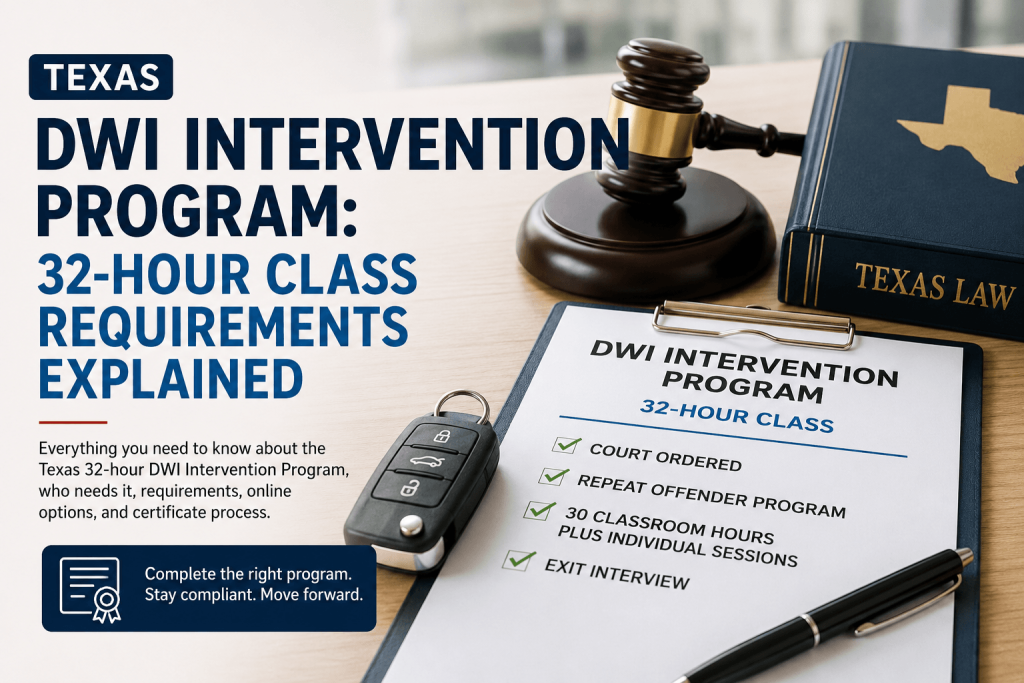
Texas’s DWI Intervention Program is the repeat-offender course generally defined as a 32-hour program. Texas DPS lists a 32-hour requirement for repeat offenders, while TDLR explains the program as at least 30 classroom hours plus two separate sessions and an exit interview. Trainees should enroll only with a TDLR-listed provider and confirm the exact course, deadline, and certificate goal with their court, probation officer, attorney, or DPS before registering.
A court order demanding a DWI-related class may select either a DWI Education Program or a DWI Intervention Program. These are not interchangeable. The DWI Intervention Program is generally planned for repeat offenders and individuals whose alcohol- or drug-related cases require a more complex intervention than the standard first-offender education course.
Before registering, check the wording on your court order, probation paperwork, bond requirements, attorney instructions, or Texas Department of Public Safety compliance notice. Choosing the wrong program could slow the completion of your legal or driver’s license requirements.
What Is the Texas DWI Intervention Program?
The Texas DWI Intervention Program is a structured course regulated by the Texas Department of Licensing and Regulation also known as TDLR, also known as TDLR. It is created primarily for people with multiple DWI offenses or alcohol- or drug-related problems that were not sufficiently addressed through a first-offender education program.
The course focuses on recognizing dangerous behavior patterns, understanding substance-related risks, developing personal responsibility, and decreasing the likelihood of future impaired-driving offenses. TDLR determines subjects such as chemical dependency, impacts on family members, relapse prevention, treatment options, problem-solving, and unique action planning as important parts of the curriculum.
Who May Be Required to Complete the Program?
The DWI Intervention Course is most typically associated with repeat DWI cases. A magistrate may need a person sentenced for certain repeat intoxication offenses to complete an approved repeat-offender educational program as part of society management or another court-ordered condition. The program is controlled through TDLR under Texas law.
You may be required to complete the program by:
- A criminal court
- A probation or district supervision department
- An attorney taking your case
- Texas DPS, as part of a driver-license compliance condition
- Another official agency is supervising your case
However, having two DWI-related incidents does not automatically mean you know which exact course to select. Court orders and unique submission conditions can differ. Always confirm the needed program before paying or enrolling.
Is It a 30-Hour or 32-Hour DWI Program?
The course is widely called the Texas 32-Hour DWI Intervention Program or the DWI Repeat Offender Program.
Texas DPS states that the class condition for a repeat offender is 32 hours. TDLR’s official program outline describes the DWI Intervention curriculum as needing a minimum of 30 hours and separately requires sessions and an exit interview.
This is why trainees may see both “30-hour” and “32-hour” wording while studying the course. The safest strategy is to register for the exact TDLR-regulated DWI Intervention Program, rather than selecting a course based only on the number of hours shown in a promotion.
Main Texas DWI Intervention Program Requirements
Complete the Necessary Curriculum
Trainees must complete all needed course modules. Texas enforcement advice states that modules must be completed in the proper sequence. A trainee normally cannot skip sections or satisfy only part of the curriculum.
Attend the Mandatory Personal Sessions
In addition to group education, the program includes two separate sessions and an individual exit interview for each trainee. These conditions distinguish the intervention program from a shorter, general education course.
Follow Attendance Regulations
Attendance is an essential course condition. Arriving late, leaving early, missing a class, disconnecting from an online class, or failing to remain visible on camera may prevent the provider from recording the session as completed.
Because class schedules and make-up guidelines can vary, trainees should ask the provider about attendance requirements before the first class.
Experience in Screening and Course Activities
Court-ordered education programs may include enrollment, data collection, an approved screening instrument, course evaluations, referrals, and an exit interview. Screening results may mean that further evaluation, counseling, or treatment help should be considered.
Completing the course itself should not be interpreted as a clinical diagnosis or a replacement for treatment when treatment has been separately ordered or recommended.
What Topics Are Covered?
The Texas DWI Intervention Course is more complex than the normal DWI Education Program. Its curriculum may address:
- Lifestyle and decision-making habits
- Individual values and responsibility
- Self-esteem and irrational ideas
- Physical and psychological consequences of alcohol and drugs
- Alcoholism and chemical dependency
- Consequences of substance misuse on family members
- Treatment and community-support options
- Relapse prevention
- Peer pressure
- Problem-solving strategies
- Personal action planning
The goal is not simply to examine traffic laws. The course is created to help trainees identify recurring behavior patterns and develop strategies intended to stop future alcohol- or drug-related problems.
Can the Texas DWI Intervention Program Be Completed Online?
Texas DPS states that an authorized repeat-offender education course may be completed online, and TDLR provides a course-search system that permits trainees to locate DWI Intervention providers.
An authorized online course is typically not a self-paced group of recorded videos. Texas online-course rules need real-time, interactive education with working audio and video equipment. Trainees may be required to remain visible on camera, respond to the educator, and attend each session at its planned time.
Before registering for an online class, confirm:
- The provider is listed for the DWI Intervention Program.
- The provider is authorized to offer the course online.
- Your court or probation officer allows online completion.
- Your device has a working camera, microphone, and stable internet connection.
- The planned dates allow you to finish before your deadline.
How to Choose the Correct Provider
TDLR handles Texas court-ordered DWI Education and DWI Intervention providers. Trainees should verify the provider through the official TDLR course-search system before registration.
Do not rely only on phrases such as:
- “Court approved”
- “Accepted everywhere”
- “Guaranteed certificate”
- “Instant online DWI class”
- “Complete at your own pace”
An honest provider should clearly specify the course as the Texas DWI Intervention Program, describe whether it is online or in-person, provide a full plan, and explain its attendance and certificate procedures.
No provider should guarantee acceptance by every court, probation department, or government agency. Final approval counts on the authority taking the particular case.
Registration and Completion Process
The usual process includes the following stages:
1. Check Your Legal Documents
Check your court order, probation contract, DPS notice, or attorney’s written instructions. Look for terms such as:
- DWI Intervention
- Repeat Offender Program
- DWII
- 32-hour program
- Article 42A.404 program
2. Ensure the Requirement
Contact the court, probation authority, attorney, or DPS when the wording is unclear. Ask for the exact program name and completion deadline.
3. Verify the Provider
Use the TDLR course-search system to confirm that the provider offers the correct DWI Intervention endorsement.
4. Register for a Suitable Schedule
Select dates that allow enough time for every class, the individual sessions, the exit interview, and certificate processing.
5. Complete Every Requirement
Attend all scheduled modules and complete the required screening, personal sessions, evaluations, and exit interview.
6. Get and Submit the Certificate
Obey the instructions provided by your court, probation department, attorney, or DPS. Do not think that receiving a certificate automatically completes every compliance requirement.
How Does the Completion Certificate Work?
Texas laws require the provider to issue the specified certificate of fulfillment after a trainee completes the applicable program. TDLR enforcement guidance states that the certificate should be provided within five days of successful completion. It also means that the official certificate should not be delivered electronically.
For DWI Intervention courses, the instructor also has reporting responsibilities concerning the appropriate community supervision department and the Texas DPS. Official advice refers to information and certificate forwarding within ten working days after completion, or before the participant’s deadline when that deadline occurs sooner.
Even when the provider reports completion, students should keep their original certificate and confirm that the receiving agency has updated its records.
Does the Provider Send the Certificate to Court, Probation, or DPS?
The Course provider may have reporting duties, but the trainees should not assume that every required agency automatically receives or processes the certificate.
Certificate procedures may depend on:
- The county and court handling the case
- The probation department
- Whether the requirement concerns community care
- The person’s DPS driver’s license record
- The deadline listed in the court order
- Whether an attorney is submitting compliance documents
Ask the provider who receives a copy and ask the supervising authority whether you must personally submit the original or an additional copy.
Will the Course Automatically Reinstate a Driver’s License?
Not necessarily.
Completing the needed course may satisfy one driver-license compliance item, but DPS may require other steps. Depending on the case, these may include completing a suspension period, paying reinstatement or other special fees, keeping an SR-22 insurance certificate, or satisfying additional court requirements.
Trainees can check their Texas driver eligibility status to determine which requirements remain. Course providers cannot guarantee when DPS will update a driver record or restore driving privileges.
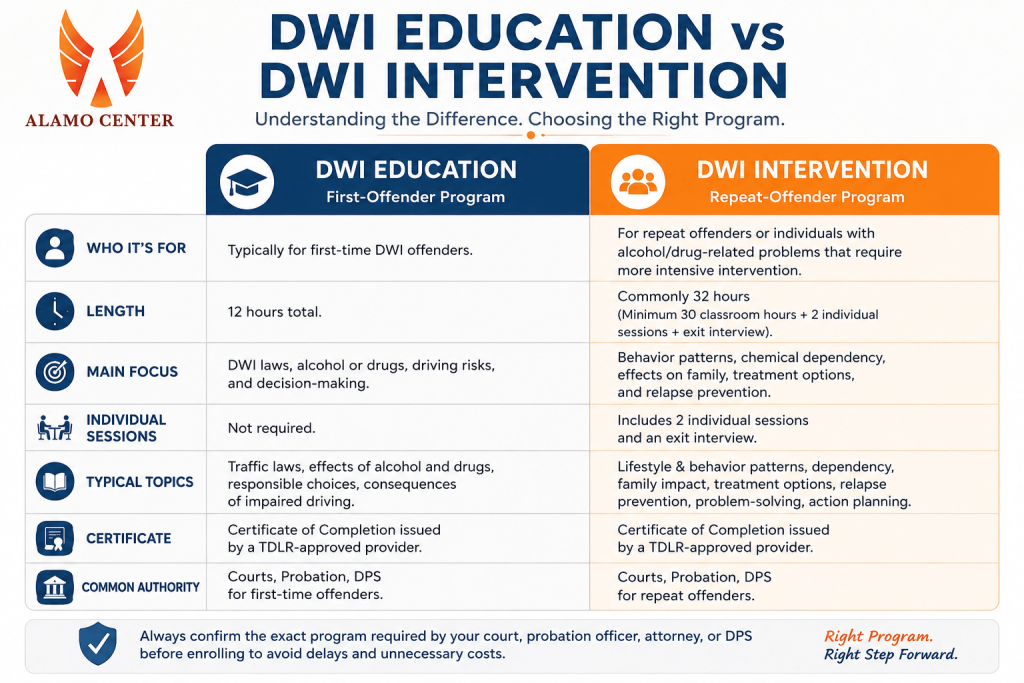
A 12-hour DWI Education certificate should not be assumed to satisfy a DWI Intervention order.
Common Mistakes to Avoid
One of the most serious mistakes is registering for the wrong course. A participant may complete a 12-hour DWI Education class only to discover that the court required the repeat-offender DWI Intervention Program.
Other common problems include:
- Registering with a provider that is not listed by TDLR
- Skipping a class or a required personal session
- Selecting dates that extend beyond the court deadline
- Taking an online self-paced class will be accepted
- Using a device without reliable audio or video
- Failing to verify where the certificate must be sent
- Thinking course completion automatically reinstates a license
- Waiting until the final week before the deadline
Confirming these details before enrollment can stop unnecessary delays and additional expenses.
Frequently Asked Questions
1. Who normally takes the Texas DWI Intervention Program?
The schedule is normally intended for repeat DWI offenders or someone ordered to complete a more intensive intervention program. The exact requirement should be confirmed through the court, probation authority, attorney, or DPS.
2. Is the Texas repeat-offender DWI course 32 hours?
Texas DPS defines the repeat-offender requirement as 32 hours. TDLR’s overview recognizes at least 30 classroom hours together with required personal sessions and an exit interview.
3. Can the DWI Intervention Program be taken online?
An authorized program may be offered online. Confirm that the provider has the correct TDLR program approval and that your court or probation authority allows online attendance.
4. Is an online course self-paced?
Normally, no. Texas online court-ordered courses use scheduled, real-time, interactive education with functioning audio and video equipment.
5. Can I miss one class and still receive my certificate?
Trainees must complete the required modules in sequence. Missing a session may delay completion or require another arrangement under the provider’s attendance policy.
6. Does the provider send my certificate to DPS?
DWI Intervention instructors have reporting and certificate-forwarding responsibilities, but trainees should still confirm that DPS received and processed the information.
7. Will every Texas court accept the same certificate?
Approval cannot be guaranteed. The course should be completed through a properly licensed provider, but the trainee must confirm the requirement with the court or probation department handling the case.
8. Is the 12-hour DWI Education course the same as DWI Intervention?
No. The 12-hour education course is normally associated with first offenders, while the longer intervention program is intended for repeat offenders or more complex circumstances.
9. Will completing the class immediately reinstate my license?
Not always. DPS may require further compliance items, fees, insurance documentation, or completion of a suspension period.
10. What should I confirm before enrolling?
Verify the exact course name, TDLR provider status, online or in-person eligibility, attendance schedule, completion deadline, certificate procedure, and the agency that must receive proof of completion.
Complete the Correct Program Before Your Deadline
The Texas DWI Intervention Program involves more than attending a general alcohol-awareness class. It is a structured repeat-offender program with demanded curriculum modules, personal sessions, an exit interview, and formal certificate procedures.
Before enrolling, contact Alamo Center to verify current DWI Intervention course availability and compare the program details with your court, probation, attorney, or DPS paperwork. Final course selection and certification acceptance should always be confirmed with the authority responsible for your case.