

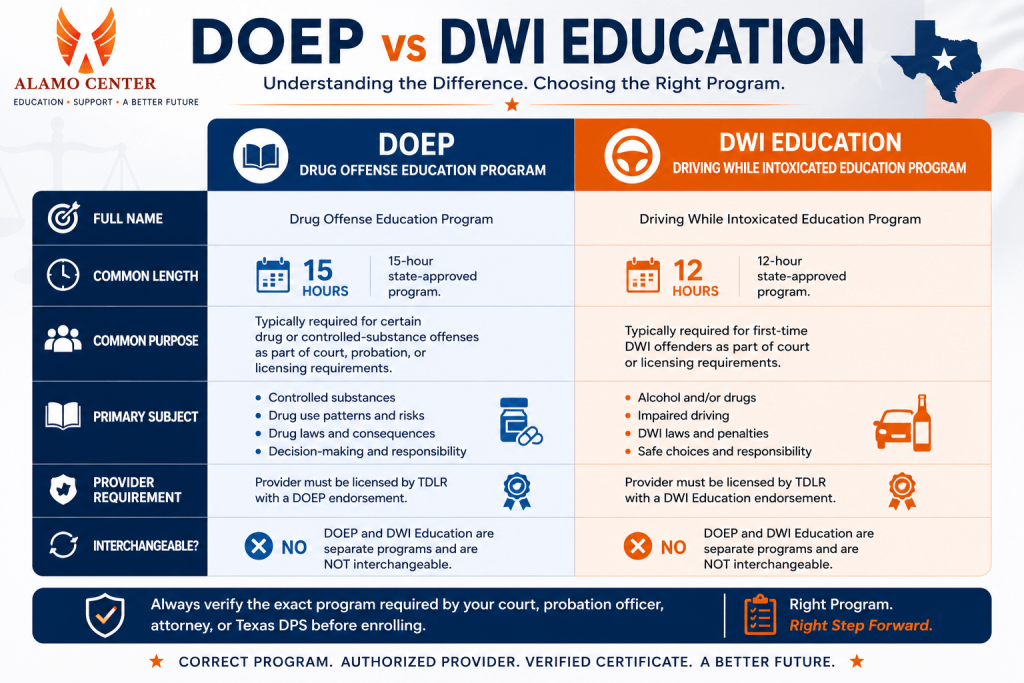
A Texas Drug Offense Education Program, generally called DOEP, may be needed after particular drug or controlled-substance offenses, through a court or supervision order, or as part of resolving a Texas driver-license suspension. DOEP is a 15-hour state-regulated educational course. Before enrolling, verify the exact course, provider authorization, deadline, and certificate-submission requirements with your court, probation official, attorney, or Texas DPS.
Receiving instructions to conduct a “drug class” does not always make the required program obvious. Texas has different court-ordered education programs, and they are not interchangeable. An individual required to complete DOEP should register especially for the Drug Offense Education Program, rather than a general substance-use course, counseling program, or DWI class.
Completing the wrong program may result in a court, supervision department, or Texas Department of Public Safety refusing to treat the requirement as satisfied.
What Is the Texas DOEP Class?
The DOEP Class Texas is designed as an educational course regulated by the Texas Department of Licensing and Regulation, generally known as TDLR.
TDLR lists Drug Offense Education as one of the state’s regulated court-ordered education programs, together with DWI Education, DWI Intervention, and Alcohol Education for Minors. Providers must hold the proper DOEP endorsement before offering the course.
The course is designed to educate people about:
- Drug-use patterns and associated risks
- The physical and psychological effects of controlled substances
- Texas drug laws and legal effects
- Decision-making and personal responsibility
- Communication and relationship problems
- Society support and treatment resources
- Strategies intended to reduce future drug-related manners
DOEP is mainly an educational program. It should not automatically be treated as substance-abuse counseling, treatment, rehabilitation, or a clinical evaluation.
Who May Need a DOEP Class in Texas?
Someone may be required to complete a Texas DOEP course when the requirement appears in a:
- Criminal court order
- Probation or community-supervision agreement
- Deferred-disposition requirement
- Lawyer’s compliance instructions
- Texas DPS suspension notification
- Driver-license eligibility document
- Requirement imposed by another official agency
Texas DPS states that a person sentenced for a qualifying drug or controlled-substance offense may be required to complete an approved 15-hour Drug Education Program as part of resolving the related driver-license consequences.
However, the existence of a drug charge does not by itself establish every unique requirement. The correct course, deadline, reporting process, and license consequences depend on the official documents associated with the case.
Is DOEP a 15-Hour Course?
Yes. Texas recognizes Drug Offense Education as a 15-hour program. Texas DPS refers to a 15-hour state-approved drug education course, and TDLR’s official program outline likewise identifies the Drug Offense Education Program as a 15-hour course.
Trainees should verify that the provider is offering the complete Texas DOEP curriculum. A shorter online awareness class, general drug course, or out-of-state program should not be assumed to satisfy a Texas DOEP requirement.
Is DOEP the Same as Substance-Abuse Counseling?
No. DOEP and substance-abuse counseling serve different purposes.
DOEP
DOEP is a standardized educational course. It typically covers drug-related laws, health effects, behavior patterns, decision-making, matters, and available support resources.
Counseling or Treatment
Counseling and treatment are individualized services that may involve assessment, diagnosis, treatment planning, therapy, healing support, or clinical monitoring.
A court or probation department may require:
- DOEP only
- An alcohol or drug evaluation
- Counseling or treatment
- Both DOEP and counseling
- Another specialized intervention
Completing DOEP does not automatically replace counseling, treatment, or an evaluation when one of those services has been ordered separately.
When Is DOEP Connected to a Driver-License Suspension?
Texas DPS explains that certain drug or controlled-substance convictions can lead to driver-license consequences. Its recommendation lists a 90-day suspension and completion of an authorized 15-hour Drug Education Program among the applicable requirements.
For the specific DPS drug-education suspension described on the agency’s authorized pages, DPS also specifies additional compliance steps, including:
- Completing the authorized 15-hour drug education course
- Paying the appropriate reinstatement fee
- Resolving any other outstanding fees
- Obtaining an SR-22 Financial Responsibility Insurance Certificate
- Maintaining the SR-22 for the required period
DPS states that the SR-22 must be maintained for two years from the date of conviction for the drug offense. These conditions may not apply identically to every case. Trainees should rely on their own DPS eligibility record and official enforcement notice.
Will Completing DOEP Automatically Reinstate Your License?
No. Completing DOEP may satisfy one part of a driver-license reinstatement process, but it does not necessarily restore driving privileges immediately.
A person may still need to:
- Complete the appropriate suspension period.
- Pay the required reinstatement fee.
- Pay other outstanding fees.
- Submit or maintain an SR-22.
- Resolve unrelated enforcement actions.
- Wait for DPS to receive and process the required documents.
- Confirm that the driver record has been updated.
DPS provides an online License Eligibility system for checking special requirements and paying reinstatement fees. DPS notes that online fee processing normally takes approximately 24–48 hours, although processing of course records or other documentation may follow a different timeline.
Do not drive until DPS ensures that your license or driving privilege is eligible.
How to Confirm Whether You Need DOEP
Before enrolling, review every document connected to your case. Look for wording such as:
- Drug Offense Education Program
- Drug Offender Education Program
- DOEP
- 15-hour drug education course
- TDLR-approved drug education program
- DPS drug-education requirement
When the wording is unclear, contact the authority that issued the requirement.
Questions to Ask the Court or Probation Officer
- Is the required course specifically Texas DOEP?
- Must the provider be licensed by TDLR?
- Is an online course permitted?
- What is the completion deadline?
- Who must receive the certificate?
- Must the original certificate be submitted?
- Is counseling or an evaluation also required?
Questions to Ask Texas DPS
- Is DOEP listed as an outstanding requirement?
- Has DPS received proof of completion?
- Is an SR-22 required?
- What fees remain outstanding?
- Has the suspension period ended?
- Are there other enforcement actions on the license?
How to Choose an Authorized DOEP Provider
TDLR regulates Texas court-ordered education providers. A provider must hold the correct Drug Offense Education Program endorsement before offering the course.
Before registering:
- Search for the provider through the official TDLR course directory.
- Confirm that the provider offers Drug Offense Education.
- Verify whether the course is online, in person, or both.
- Confirm the complete 15-hour schedule.
- Ask about attendance and make-up rules.
- Confirm how and when the certificate is issued.
- Verify certificate-submission responsibilities.
- Compare the dates with your court or DPS deadline.
Avoid choosing a course solely because its advertising uses phrases such as:
- “Accepted everywhere”
- “Instant certificate”
- “Guaranteed court approval”
- “Complete in a few hours”
- “Self-paced Texas drug class”
No provider should guarantee acceptance by every court, probation department, or government agency.
Can a Texas DOEP Class Be Completed Online?
TDLR licenses court-ordered program providers with online, in-person, or combined acceptance. A provider must be trusted for the delivery method it uses.
An online course should therefore be verified in two ways:
- Confirm that the provider holds the proper DOEP endorsement.
- Confirm that the provider is authorized to deliver the course online.
Trainees should also receive confirmation from the court, probation official, lawyer, or DPS when online acceptance is not clear from their documents.
An approved online class may still require scheduled attendance, live participation, identity verification, a working camera and microphone, and compliance with instructor rules. It should not be considered to be an unsupervised, self-paced video course.
What Happens During the DOEP Class?
The exact class program depends on the licensed provider, but a participant can normally expect:
- Enrollment and identity verification
- Scheduled instructional sessions
- Course materials and structured modules
- Instructor-led discussions
- Pre-course or post-course activities
- Participation requirements
- Information about drug-related laws and consequences
- Discussion of behavior patterns and decision-making
- Information about counseling, treatment, and community resources
- Completion documentation after all requirements are met
Students should arrive or log in on time and remain present throughout every session. Missing part of the course may delay completion and certificate issuance.
Typical DOEP Enrollment Process
Step 1: Review Your Paperwork
Identify the exact name of the program, deadline, and responsible agency.
Step 2: Confirm the Requirement
Contact the court, probation department, lawyer, or DPS if the paperwork merely says “drug class.”
Step 3: Verify the Provider
Confirm that the school is listed by TDLR and holds the DOEP endorsement.
Step 4: Select the Correct Delivery Method
Choose an online or in-person course only after confirming that the format is acceptable.
Step 5: Check the Full Schedule
Make sure you can attend every required session and complete the full 15 hours before your deadline.
Step 6: Complete the Course
Follow all attendance, participation, identity-verification, and conduct requirements.
Step 7: Obtain the Certificate
Check the certificate carefully for correct identifying information and course details.
Step 8: Confirm Submission
Determine whether the provider reports completion, whether you must submit the certificate, or whether both actions are required.
Step 9: Verify Compliance
Contact the court, probation department, or DPS to confirm that the requirement has been recorded as completed.
How Does the DOEP Certificate Work?
After successful completion, the provider issues the required completion documentation according to Texas program rules and its accepted procedures.
The certificate should generally reflect accurate information such as:
- Participant’s legal name
- Program completed
- Provider information
- Completion date
- Required identifying or certificate details
Review the certificate immediately. A misspelled name, incorrect date, or wrong program title could delay processing. Do not assume the certificate has automatically reached every relevant agency.
Where Should the DOEP Certificate Be Sent?
The correct destination depends on why the course was required.
The certificate may need to be submitted to:
- The sentencing court
- A court clerk
- A probation or community-supervision officer
- An attorney
- Texas DPS
- Another supervising agency
A provider may report fulfillment under applicable procedures, but the participant should still confirm:
- Who is responsible for submitting proof
- Whether an original or a copy is required
- Whether electronic submission is accepted
- Whether separate proof must be sent to the court and DPS
- Whether the receiving agency has processed the certificate
Keep a copy of the certificate and all submission confirmations.
Common Mistakes That Cause Delays
Enrolling in a General Drug-Awareness Course
A generic course may not satisfy a Texas DOEP order.
Taking the Wrong Texas Program
DOEP, DWI Education, DWI Intervention, and Alcohol Education for Minors are separate programs.
Using an Unverified Provider
The provider should hold the correct TDLR approval and, when relevant, online authorization.
Missing a Session
The course requires fulfillment of the full curriculum. Missing class time may prevent successful completion.
Waiting Until the Deadline
Certificate processing and agency record updates may take additional time.
Assuming the Provider Handles Everything
The trainee may still be responsible for delivering proof to the court, probation department, or DPS.
Assuming DOEP Alone Reinstates the License
Additional suspension, fee, SR-22, or enforcement requirements may remain.
Driving Before Eligibility Is Restored
Course completion does not itself authorize a person to drive. Verify eligibility directly with DPS.
Frequently Asked Questions
1. What does DOEP mean in Texas?
DOEP generally refers to the Texas Drug Offense Education Program, a state-regulated educational course for certain court, supervision, or driver-license requirements.
2. How long is the Texas DOEP class?
The Texas Drug Offense Education Program is a 15-hour course.
3. Who normally needs DOEP?
It may be required for individuals with certain drug or controlled-substance cases, people under a court or probation order, or people resolving a related Texas driver-license suspension.
4. Can I take DOEP online?
A licensed provider may offer an online DOEP course when it holds the appropriate TDLR acceptance. Confirm online eligibility with the authority handling your case.
5. Is DOEP the same as drug counseling?
No. DOEP is an educational program. Counseling, treatment, and clinical evaluations are separate services and may be ordered in addition to DOEP.
6. Does every drug charge require DOEP?
Not necessarily. The requirement depends on the conviction, court order, supervision conditions, DPS record, and other case-specific circumstances.
7. Will DOEP reinstate my Texas driver’s license?
DOEP may satisfy one reinstatement requirement, but additional requirements can include completing the suspension period, paying fees, maintaining an SR-22, and resolving other enforcement actions.
8. How much is the DPS education program reinstatement fee?
DPS lists a $100 reinstatement fee for an education-program suspension, in addition to other outstanding fees that may apply.
9. Does the provider send my certificate to DPS?
Provider reporting procedures can vary according to the program and applicable rules. Confirm directly with the provider and DPS instead of assuming the certificate was automatically received.
10. What should I verify before enrolling?
Confirm the exact course name, provider authorization, delivery format, schedule, deadline, certificate procedure, receiving agency, DPS requirements, and whether any counseling or evaluation is also required.
Complete the Correct Texas Drug Education Program
A Texas DOEP class is a specific 15-hour Drug Offense Education Program—not a generic drug-awareness course or DWI class. The safest approach is to verify the requirement first, select a properly licensed provider, complete every organized session, retain the certificate, and confirm that the appropriate court, probation department, or DPS record has been updated.
Contact Alamo Center to review current DOEP course availability, scheduling options, enrollment requirements, and certificate procedures. Before registering, compare the course information with the instructions issued by your court, probation officer, attorney, or Texas DPS.