
An alcohol evaluation in Texas is a structured examination used to review an individual’s alcohol or substance-use history, related behaviors, and probable need for education, counseling, treatment, or further evaluation. A court, probation division, lawyer, or other referring authority may request an evaluation after a DWI or another alcohol-related matter.
Because conditions differ by case, participants should ensure the required assessment type, provider qualifications, completion deadline, report format, and submission procedure before registering.
What Is an Alcohol Evaluation?
An alcohol evaluation is a screening and assessment procedure that examines how alcohol or other substances may have impacted someone’s fitness, behavior, relationships, career, driving history, or legal affairs.
It may also be called:
- An alcohol assessment
- A substance-use assessment
- A substance abuse evaluation
- A court-ordered alcohol assessment
- A DWI alcohol evaluation
- A SASSI alcohol evaluation
During the evaluation, the participant may answer questions about existing and earlier alcohol or drug use, prior legal incidents, family history, treatment history, effects of substance use, and any previous education or counseling.
The objective is normally to provide structured information and determine whether additional services may be applicable. An alcohol evaluation is not automatically the same as a medical diagnosis, treatment program, or DWI education course.
When Is a Court-Ordered Alcohol Evaluation in Texas Required?
A court-ordered alcohol evaluation in Texas may be required when a magistrate, probation division, lawyer, or another authorized group needs additional information about an individual’s alcohol or substance-use patterns.
Common concerns may include:
After a DWI charge or conviction
A DWI alcohol evaluation may be requested after an arrest, trust, plea agreement, or probation placement involving driving while intoxicated.
The evaluation may help the referring authority understand:
- The possibilities surrounding the incident
- Whether there is a history of alcohol or drug use
- Whether previous alcohol-related incidents occurred
- Whether education, counseling, monitoring, or treatment may be appropriate
An evaluation does not guarantee a clear court outcome and should not be completed as a substitute for legal recommendation.
As part of the probation requirements
An alcohol assessment for probation may be needed as a condition of community care. The probation department may specify:
- Which type of assessment is required
- Who is eligible to conduct it
- Whether it may be conducted online
- When must it be completed
- Who must receive the report
- Whether additional recommendations must be followed
Participants should obey the written probation instructions rather than thinking that any general assessment will fulfill the requirement.
Before a court hearing
A lawyer may suggest completing an evaluation before a court appearance, sentencing hearing, or case review. However, the timing and disclosure of an evaluation can have legal importance.
A person represented by a lawyer should discuss the evaluation with the attorney before completing it or submitting the report.
Following another alcohol- or drug-related offense
A substance abuse evaluation in Texas may also be requested when a case concerns:
- Alcohol-related public offenses
- Drug control
- Prescription medication misuse
- Underage alcohol-related conduct
- Probation violations
- Other substance-related allegations
Some evaluations address alcohol only, while others assess both alcohol and drug-use practices.
What Happens During a Court-Ordered Alcohol Assessment?
The exact process depends on the provider and the referring authority. However, a court-ordered alcohol assessment generally includes several stages.
1. Review of the referral requirement
The provider may ask for information about:
- The court or county
- The probation department
- The lawyer
- The case or cause number
- The reason for the referral
- The completion deadline
- The required report recipient
Providing correct information can help prevent administrative delays.
2. Identity and background information
Participants may provide identification, contact information, legal history, work details, medical information, and previous education, counseling, or treatment history.
3. Alcohol and substance-use questions
The evaluation may examine:
- Frequency of alcohol use
- Amount typically consumed
- Drug-use history
- Previous attempts to reduce use
- Legal or personal consequences
- Family history
- Driving-related incidents
- Previous treatment or counseling
Honest and complete responses are important because irregular answers can affect the usefulness of the assessment.
4. Screening instrument or interview
The provider may use a standardized screening instrument, a professional interview, or both.
One possible option is a SASSI alcohol evaluation, which uses structured questions to determine indicators associated with substance-use problems. The specific instrument required should be verified with the court, probation officer, lawyer, or referring authority.
5. Findings and recommendations
After reviewing the information, the evaluator may provide findings or recommendations. Depending on the circumstances, these may include:
- No additional recommendation
- Alcohol or drug education
- Individual counseling
- Group counseling
- Treatment services
- Monitoring
- A more comprehensive clinical evaluation
A recommendation from an evaluator is not automatically the same as a court order. The court or leading authority chooses how the report will be used.
What Is a SASSI Alcohol Evaluation?
A SASSI alcohol evaluation uses the Substance Abuse Subtle Screening Inventory as part of the screening process.
The assessment includes direct and indirect questions designed to identify patterns that may be associated with substance-use concerns. It may be used when a court, probation division, lawyer, or other authority wants structured information about possible alcohol or drug-use risks.
A SASSI screening should not be treated as a stand-alone medical diagnosis. It is generally one part of a broader evaluation process.
Before completing a SASSI assessment, verify:
- Whether SASSI is the required instrument
- Whether the specific version is accepted
- Whether an interview is also required
- Who must review or score the assessment
- Who must receive the final results
Can You Complete an Online Alcohol Evaluation in Texas?
An online alcohol evaluation in Texas may be available when remote completion is permitted by the provider and accepted by the referring authority.
Online completion can be suitable for participants who have transportation, scheduling, work, childcare, or location constraints. However, availability does not automatically mean that a specific court or probation department will accept the format.
Before enrolling in an online evaluation, confirm:
- Does the court or probation department accept an online assessment?
- Is a live video interview required?
- Must the evaluator hold a particular professional license?
- Is a specific screening instrument required?
- Does the report need particular information?
- Must the provider send the report directly?
- What is the completion deadline?
- Are follow-up services required?
Alamo Center provides an online evaluation option for someone who needs a structured alcohol or substance-use assessment. Participants should verify that the service matches their specific instructions before registering.
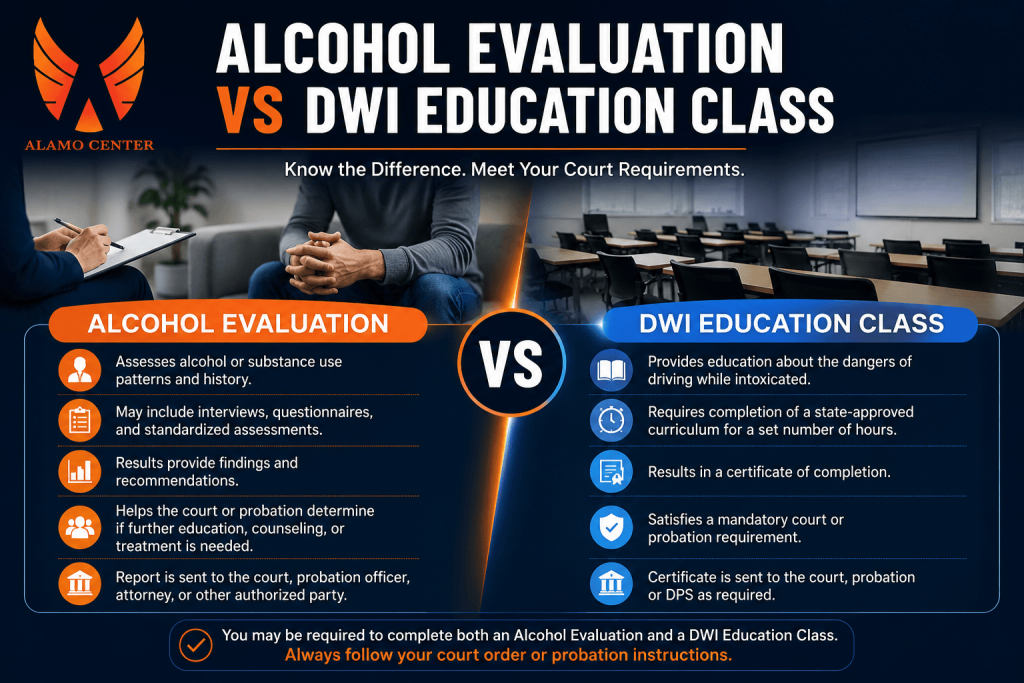
A person may be required to complete both a DWI alcohol evaluation and a DWI education course.
Do not believe that completing one requirement automatically satisfies the other. Review the exact language in the court order, probation paperwork, lawyer instructions, or administrative notice.
Alcohol Evaluation vs Substance Abuse Evaluation in Texas
The terms alcohol evaluation and substance abuse evaluation are occasionally used interchangeably, but the coverage may differ.
An alcohol-focused evaluation primarily reviews alcohol-use patterns. A substance abuse evaluation in Texas may look at alcohol, illegal drugs, prescription medications, and other substances.
The correct evaluation depends on the referral. Before enrolling, determine whether the paperwork requests:
- An alcohol-only evaluation
- A drug and alcohol evaluation
- A substance-use assessment
- A clinical assessment
- A SASSI evaluation
- A treatment recommendation
- A specific court or probation report
Choosing the wrong service may delay compliance.
How Long Does an Alcohol Evaluation Take?
Completion time depends on:
- The assessment instrument
- Whether an interview is required
- The participant’s history
- The amount of documentation involved
- Whether clarification is necessary
- The provider’s report-processing procedure
The time spent answering questions is different from the time required to score the assessment, review the results, prepare the report, and deliver it to the appropriate recipient.
Participants facing a deadline should ask when the completed report will be available—not only how long the questionnaire takes.
What Should You Prepare Before the Evaluation?
Before beginning an evaluation, gather:
- Your complete legal name
- Date of birth
- Government-issued identification, when requested
- Court and county information
- Case or cause number
- Probation officer’s contact information
- Attorney’s contact information
- Completion deadline
- A copy of the referral or court order
- Previous assessment or treatment records, when required
- Correct report-delivery instructions
Having this data ready can reduce errors and prevent the report from being delivered to the wrong person.
What Information May Be Included in the Report?
An evaluation report may contain:
- Participant identification
- Referral information
- Assessment date
- Screening instrument used
- Relevant background information
- Summary of responses
- Evaluator findings
- Recommendations
- Provider information
- Report recipient
- Completion or delivery information
The exact report format changes. Confirm whether the court or probation department requires a specific form, signature, credential, instrument, or delivery method.
Where Is the Alcohol Evaluation Report Sent?
Depending on the instructions, the report may be delivered to:
- The participant
- A probation officer
- An lawyer
- A court representative
- A treatment provider
- Another authorized recipient
Some authorities may require the provider to submit the report directly. A participant-provided copy may not always satisfy the requirement.
Before beginning, ask:
- Who receives the report?
- Does written authorization need to be completed?
- Will the participant also receive a copy?
- Is electronic delivery permitted?
- Is proof of submission provided?
How to Choose an Alcohol Evaluation Near Me
People searching for an alcohol evaluation near me should evaluate providers based on more than geographic distance.
Consider the following factors:
Correct assessment type
Confirm that the provider offers the exact service listed in your paperwork.
Online availability
A remote option may allow you to complete the evaluation without traveling, but acceptance must still be verified.
Provider qualifications
Determine whether the referring authority requires a licensed counselor, qualified evaluator, approved provider, or another credential.
Report compatibility
Ask whether the provider can prepare and deliver the required report.
Completion and processing time
Confirm how long the assessment, review, report preparation, and delivery normally take.
Communication help
Choose a provider that clearly explains the process, documentation requirements, and report-submission procedure.
Privacy practices
Ask how your information will be stored, reviewed, and disclosed.
An online provider may serve participants across Texas, but the participant remains responsible for confirming acceptance with the relevant authority.
Common Mistakes to Avoid
Several mistakes can delay completion or create problems with report acceptance.
Enrolling without confirming the requirement
A general alcohol evaluation may not satisfy a request for a clinical assessment, DWI course, treatment evaluation, or specific screening instrument.
Assuming online completion is automatically accepted.
Always verify online eligibility before enrolling.
Missing the deadline
Do not wait until the final day. The provider may need additional time to review, score, prepare, and submit the report.
Providing incorrect recipient information
Verify the probation officer, lawyer, court, email address, case number, and submission instructions.
Confusing an evaluation with a class
An evaluation does not automatically replace DWI Education, DWI Intervention, DOEP, counseling, treatment, or a Victim Impact Panel.
Giving incomplete information
Incomplete or inconsistent responses can affect the evaluation and may require clarification.
Complete an Alcohol Evaluation Through Alamo Center
Alamo Center provides an online alcohol and substance-use evaluation service for individuals who may need an assessment for:
- A court-related matter
- Probation compliance
- Attorney review
- A DWI-related case
- Another authorized referral
The online format can help participants complete the assessment without traveling to a physical location.
Before enrolling, confirm that:
- The assessment type matches your instructions
- Online completion is permitted
- The provider qualifications are acceptable
- The report format satisfies the referring authority
- The report can be delivered to the correct recipient
- The service can be completed before your deadline
Start Your Online Alcohol Evaluation
Call Now: (210) 824-5537
Contact Alamo Center to Confirm the Evaluation Process
Frequently Asked Questions
What is an alcohol evaluation in Texas?
An alcohol evaluation in Texas is a structured assessment used to review alcohol or substance-use patterns and determine whether education, counseling, treatment, or further evaluation may be appropriate.
Who may require a court-ordered alcohol evaluation in Texas?
A magistrate, the probation division, a lawyer, a treatment provider, or another referring authority may request an evaluation. The exact requirements depend on the individual case.
Can an online alcohol evaluation in Texas satisfy probation requirements?
It may satisfy the requirement when the probation department accepts the online format, provider, assessment instrument, and report. Confirm acceptance before enrolling.
What is included in an alcohol assessment for probation?
An alcohol assessment for probation may include personal history, legal history, alcohol and drug-use questions, a screening instrument, an interview, findings, and recommendations.
Is a SASSI alcohol evaluation a diagnosis?
No. A SASSI screening helps identify indicators associated with possible substance-use concerns, but it is not automatically a medical or clinical diagnosis by itself.
Is a DWI alcohol evaluation the same as a DWI class?
No. A DWI alcohol evaluation assesses alcohol or substance-use patterns, while a DWI class provides structured education. An individual may be required to complete both.
What is the difference between an alcohol evaluation and a substance abuse evaluation in Texas?
An alcohol evaluation may focus mainly on alcohol use, while a substance abuse evaluation may examine alcohol, drugs, prescription medications, and other substances.
Can I search for an alcohol evaluation near me and complete it online?
Yes, some providers offer online evaluations. However, confirm that the remote format and provider satisfy the requirements of your court, probation department, or attorney.
Can a court reject an alcohol evaluation?
A report may not satisfy the requirement when the wrong assessment, provider, format, credential, or delivery method was used. Verify all instructions before starting.
Where should my evaluation report be sent?
The report may need to be sent to your probation officer, attorney, court, or another authorized recipient. Follow the instructions provided in your case.
Final Reminder
A court-ordered alcohol assessment can be an important part of satisfying a legal, probation, or lawyer requirement. However, requirements differ across courts, counties, probation departments, and individual cases.
Before completing an alcohol evaluation in Texas, verify the correct assessment, provider qualifications, online eligibility, deadline, report format, and delivery instructions.