
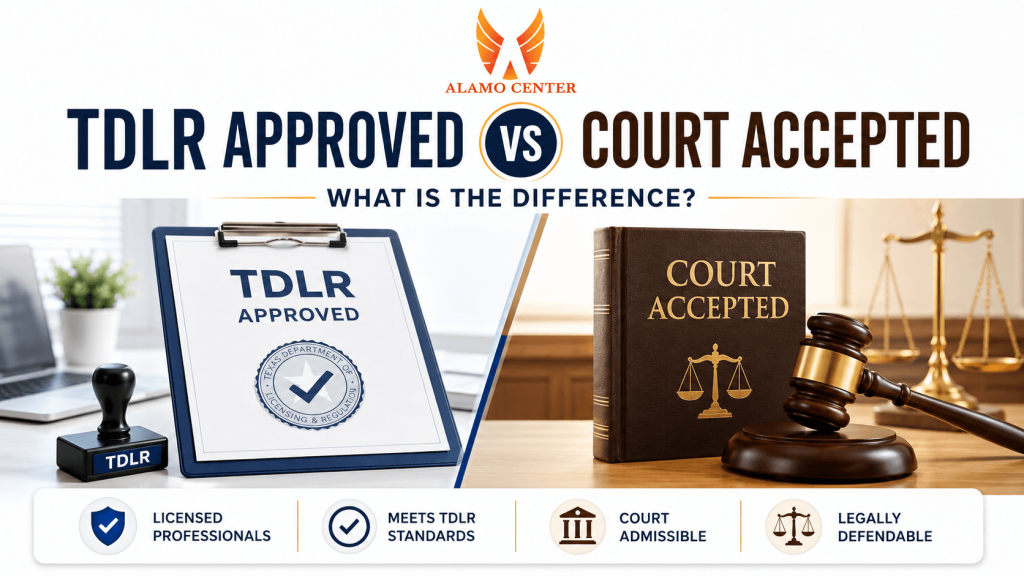
“TDLR approved” means a Texas provider and its course are licensed or regulated within TDLR’s court-ordered education system. “Court accepted” means the court, probation office, DPS, or another responsible authority accepts the completed class and certificate for a specific requirement. TDLR status is important, but it does not replace case-specific verification before enrollment.
A person searching for a court-ordered DWI or drug education course may see several similar terms: “state approved,” “TDLR certified,” “court approved,” “court accepted,” or “DPS approved.” These terms are often used together, but they do not describe the same part of the compliance process.
This difference matters because completing a legitimate course is only one part of meeting a legal requirement. The participant must also choose the correct program, complete it within the required time, receive the correct completion certificate, and submit that certificate to the proper court, probation officer, lawyer, or state agency.
Understanding TDLR-approved vs. court-accepted before paying for a course can reduce the risk of choosing the wrong program, missing a deadline, or delaying court and driver-license compliance.
What Does TDLR Approved Mean?
TDLR stands for the Texas Department of Licensing and Regulation. TDLR handles multiple court-ordered drug and alcohol education programs, including DWI Education, DWI Intervention, Drug Offense Education, and Alcohol Education for Minors.
TDLR licenses program providers and instructors. A provider may hold endorsements for one or more specific course types, and TDLR allows providers to seek approval for in-person instruction, online instruction, or both. TDLR states that a provider cannot enroll participants, schedule classes, or begin instruction until its license application has been approved.
In reasonable terms, a TDLR-approved DWI class should be connected to a provider that appears in the official TDLR course-provider directory for the exact program required. A provider authorized for DWI Education is not automatically authorized to conduct DWI Intervention or DOEP classes.
What TDLR Status Helps Confirm
- The provider is listed within the Texas regulatory system.
- The provider holds the appropriate endorsement for the course type.
- The provider is recognized as offering online or in-person instruction, where applicable.
- The provider and designated instructor are expected to hold matching program endorsements.
- The provider must follow the applicable TDLR rules and reporting requirements.
The official course search also provides filters for course type, provider, ZIP code, online-only courses, in-person courses, and Spanish-language content.
What Does Court Accepted Mean?
A court-accepted DWI class in Texas is a class that the officer responsible for the case accepts as satisfying the condition written in a court order, probation document, bond condition, plea agreement, driver-license record, or other authorized instruction.
Court acceptance is therefore case-specific. The examining authority may consider whether the correct program was completed, whether the provider held the proper license, whether the delivery format matched the requirement, whether all required hours were completed, whether the deadline was met, and whether the certificate was sent to the correct office.
Texas DPS uses a separate review step for driver-license compliance. DPS states that its Enforcement and Compliance Service reviews education certificates to determine whether they are acceptable. DPS also directs drivers to the TDLR directory to locate approved DWI Education programs, including online and in-person options.
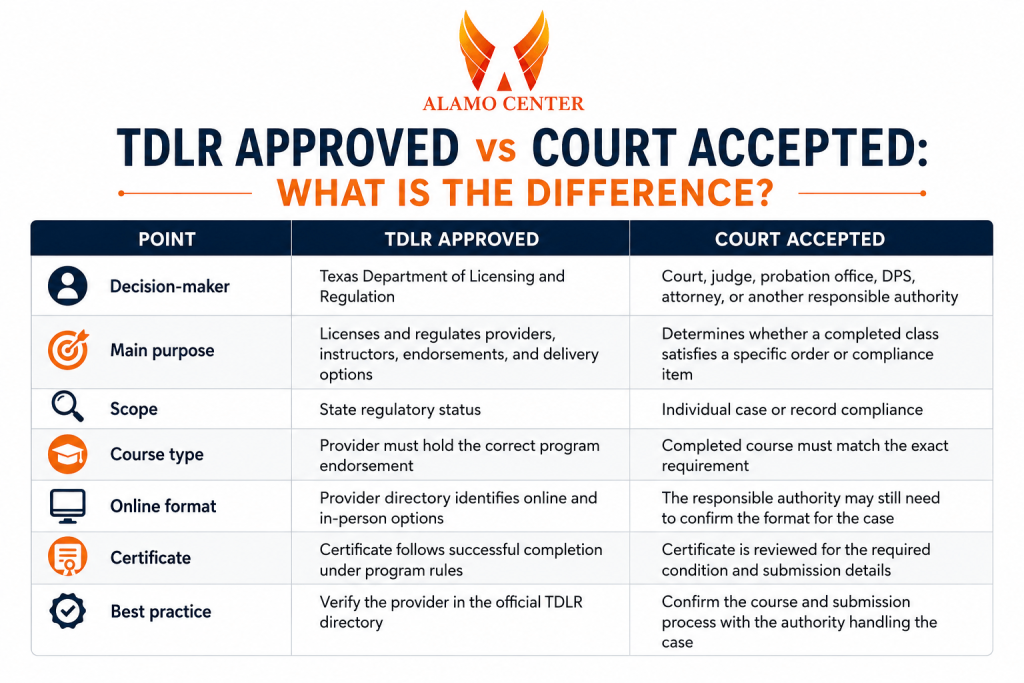
This is the central difference between TDLR-approved vs. court-accepted: TDLR status involves the provider, program endorsement, and delivery authorization. Court or agency acceptance concerns whether a participant’s completed course satisfies the requirement attached to that individual case.
Can a TDLR-Approved Class Still Cause a Compliance Problem?
Yes. A current TDLR listing is an important sign that the provider is legitimate and licensed, but it cannot correct a registration for the wrong program or guarantee that every case-specific condition has been satisfied.
For example, a participant may register for a valid 12-hour DWI Education course even though the order requires the 32-hour DWI Intervention Program. Both programs are regulated by TDLR, but they are different endorsements and serve different requirements.
Problems can also arise when a certificate is submitted after the deadline, sent to the wrong office, issued under information that does not match the record, or completed through a delivery method that was not confirmed in advance. These situations may involve a mismatch or documentation issue rather than an invalid provider.
Expected Reasons a Certificate May Not Be Accepted Immediately
The Wrong Program Was Completed
Texas has separate court-ordered education programs. DWI Education, DWI Intervention, DOEP, and Alcohol Education for Minors are not interchangeable. Compare the exact wording in the order with the course name shown in the TDLR directory.
The Provider’s Status Was Not Verified
A website may use terms such as “state recognized” or “court approved” without clearly displaying current licensing information. Verify the provider through the official TDLR course search instead of relying only on advertising language or a website badge.
The Online Format Was Not Confirmed
TDLR allows providers to be endorsed for online, in-person, or both forms of instruction. Before registering for an online DWI class in Texas, verify that the provider is listed for online delivery and ask whether the order contains any case-specific restriction.
The Course Did Not Match the Order
An order may identify the full program name, required number of hours, deadline, or another condition. Registering based only on a general phrase such as “alcohol class” can result in selecting the wrong service.
The Certificate Was Sent to the Wrong Place
Some certificates go to a probation officer or court clerk, while others may need to be submitted to an attorney or DPS. Confirm the recipient, accepted format, and submission method before the course is complete.
The Completion Deadline Passed
A legitimate certificate does not automatically remove the consequences of a missed deadline. Participants should allow time for registration, attendance, certificate preparation, delivery, and agency processing.
For DPS compliance documents, the current reinstatement page says remaining items may be submitted by mail, fax, or email; emailed documents must be PDF files. DPS also instructs drivers to include identifying information so documents can be matched to the correct record and to allow processing time.
How to Verify a Texas Court-Ordered Class Before Enrolling
1. Read the Exact Requirement
Review the court order, probation paperwork, bond documents, lawyer instructions, or DPS eligibility record. Identify the exact program name rather than relying on a general description.
2. Confirm the Required Program and Hours
Course duration can help identify the program, but the full program name is more reliable. Do not assume that every 12-hour, 15-hour, or 32-hour class serves the same purpose.
3. Search the Official TDLR Directory
Choose the required course type and verify the provider name, course category, contact information, language option, and online or in-person status.
4. Ask the Provider for Its Licensing Information
A legitimate provider should be able to identify its current provider license and explain which endorsement applies to the selected course. Independently compare that information with the state directory.
5. Confirm Acceptance With the Responsible Authority
Ask the court registrar, probation officer, lawyer, or agency contact whether the selected provider, course, and delivery format match the requirement. Written confirmation is useful when available.
6. Ask How the Certificate Will Be Delivered
Confirm whether the certificate is digital or physical, how long preparation normally takes, whether the provider sends copies to third parties, and whether the participant must submit the certificate.
7. Check DPS Eligibility Separately
A class may be only one of several DPS license reinstatement requirements. Use the DPS license eligibility system to identify remaining fees or compliance items before assuming the record is clear.
Useful verification question: “My paperwork requires [exact program name]. I plan to complete it through [provider name] using the provider’s [online/in-person] course. Will this satisfy the requirement in my case?”
Does TDLR Approval Guarantee DPS Acceptance?
No. TDLR approval is a key regulatory requirement, but DPS performs its own review of submitted education certificates. DPS states that its Enforcement and Compliance Service determines whether an education certificate is acceptable for the driver record.
A certificate may therefore require processing before an education-related compliance item is cleared. Keep a copy of the certificate and proof of submission, then check the DPS eligibility record after allowing the stated processing time.
Do not assume that emailing or mailing a certificate means the driver record has already been updated.
Are Online TDLR-Approved Classes Accepted in Texas?
TDLR’s provider system includes online endorsements, and its public course directory includes an online-only filter. DPS also states that approved TDLR DWI Education programs can include both in-person and online courses.
An online class should still be completed through a provider authorized for that program and delivery method. The participant should also confirm that the exact class matches the order or agency requirement.
Be cautious with websites promising instant certificates, self-paced completion that bypasses required participation, or unusually shortened schedules. Speed does not make a certificate useful if the underlying course does not meet the requirement.
Choosing a Verified Provider
Alamo Center offers live online Texas court-ordered education programs through Zoom, including DWI Education, DWI Intervention, and the Drug Offender Education Program. As of the verification date for this article, Alamo Center’s website identifies its TDLR provider license as No. 742. Because licensing information can change, participants should verify the current listing in the official TDLR directory at the time of enrollment.
Before enrolling, compare the exact requirement with Alamo Center’s DWI Education Program, DWI Intervention Program, or Drug Offender Education Program. Contact the court, probation officer, lawyer, or DPS when the required program is unclear.
Frequently Asked Questions
Is TDLR approval the same as court approval?
No. TDLR status concerns the provider, instructor, endorsement, and permitted delivery method. Court acceptance concerns whether the specific completion satisfies the requirement in the participant’s case.
Can a court reject a TDLR-approved DWI class?
A court may decide that a completion does not satisfy its order if the wrong program was taken, a deadline was missed, the certificate was incomplete, or another case-specific condition was not met.
How do I check whether a provider is TDLR approved?
Use the official TDLR Court-Ordered Education Course Search. Select the correct course type and review the provider’s online or in-person options.
Does a TDLR-approved online class work for every Texas court?
Online providers can be authorized by TDLR, but participants should still confirm the exact course and format with the authority handling the case.
What is the difference between DWI Education and DWI Intervention?
They are separate TDLR endorsements. DWI Education is a different program from DWI Intervention, which is commonly associated with repeat-offender requirements. Follow the exact wording in the order.
Does the provider automatically send my certificate to court?
Certificate procedures vary. Ask whether the provider sends copies to a court, attorney, probation officer, or DPS, and confirm receipt when submission is required.
Will completing the class automatically reinstate my driver license?
No. Education may be one compliance item among several. Check the DPS license eligibility system for all required documents and fees.
Who decides whether DPS accepts my certificate?
DPS states that its Enforcement and Compliance Service reviews education certificates and determines whether they are acceptable for the driver record.
Should I ask my lawyer before choosing a class?
Ask an attorney when the order is unclear, the case is pending, the class is being taken from outside Texas, or the paperwork contains a special condition. A provider can explain its course but cannot give legal advice.
What records should I keep after completing the course?
Keep the completion certificate, payment receipt, registration confirmation, attendance communications, provider details, and proof of submission.
Final Thoughts
The difference between TDLR-approved vs. court-accepted comes down to regulatory authorization and individual compliance. TDLR verifies that a provider is authorized to offer a particular court-ordered education program. The court, probation department, DPS, or another authority then determines whether the completed class satisfies the requirement under its control.
Reduce avoidable delays by checking the provider in the official TDLR directory, matching the course to the paperwork, confirming online or in-person eligibility, and asking where the certificate must be sent. Verification before enrollment is usually easier than correcting a mismatch after the class has been completed.