
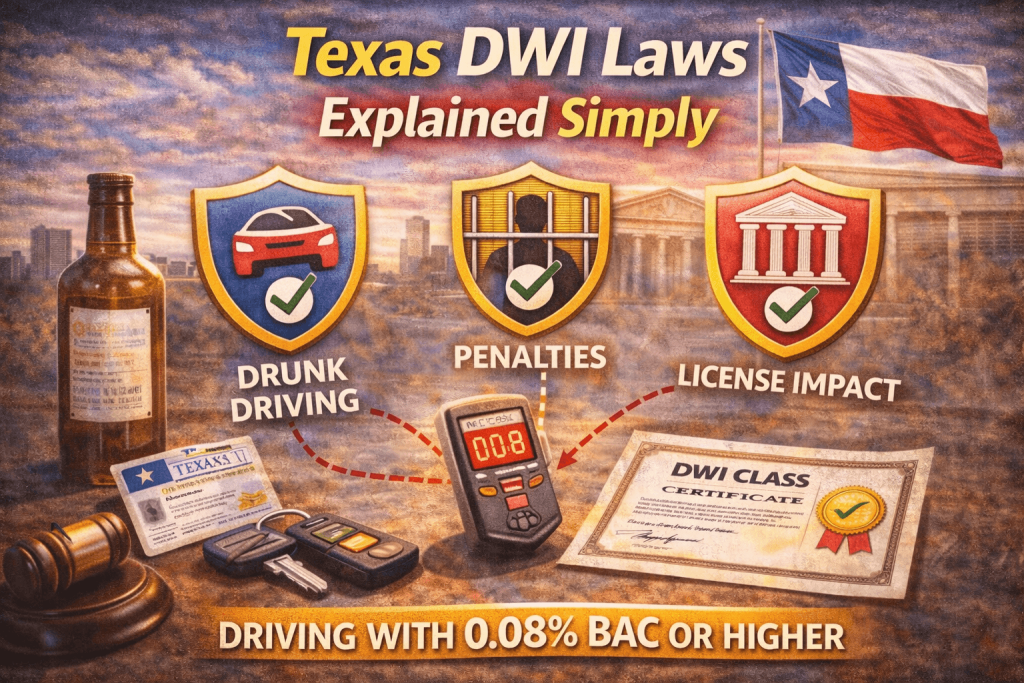
Texas DWI laws are not hard to understand after all, particularly if you are in the dock or someone close to you winds up there. Nevertheless, keeping one thing in mind makes for better judgment and fewer conflicts with the law later on:
We break down Texas DWI laws to provide a clear and concise explanation. This will include what legally constitutes driving in the state of Texas, how much alcohol you can have in your bloodstream at any given time, penalties, and what happens after an arrest.
What Is a DWI in Texas?
The term DWI (Driving While Intoxicated) in Texas means operating a motor vehicle when your mental or physical abilities are impaired by drugs, alcohol, or other substances. You can be charged with a DWI if:
- Your blood alcohol concentration (BAC) is 0.08% or higher, or
- You are unable to drive safely because of intoxication—even if your BAC is below 0.08%
This shows that impairment is more important than figures.
Legal BAC Limits in Texas
Texas has tough BAC limits depending on the type of driver:
- 0.08% – Legal and Standard limit for most drivers
- 0.04% – Commercial drivers
- 0.00% – Drivers under 21 (zero-tolerance policy)
Even a small amount of alcohol can result in a charge if it impacts your driving ability.
What Happens During a DWI Stop?
If a police authority suspects you of harming while driving, they may:
- Pull you through
- Ask queries about alcohol or drug use
- Work field sobriety tests
- Request a breath or blood test
Texas tracks an implied license law, suggesting that by driving, you agree to chemical testing.
Refusing a Test
If you deny a breath or blood test:
- Your license may be automatically suspended
- The rejection can be used against you in court
Penalties for DWI in Texas
The fines depend on whether it is your first, second, or third offense.
First Offense:
- Fine up to $2,000
- Jail period (3 to 180 days)
- License suspension up to 1 year
Second Offense:
- Fine up to $4,000
- Jail period (30 days to 1 year)
- License suspension up to 2 years
Third Offense:
- Fine up to $10,000
- Prison penalty (2 to 10 years)
- Long-term license suspension
Additional fines may apply if:
- Your BAC is very high
- A child was in the vehicle
- An accident caused injury or death
DWI Education and Intervention Programs
Texas law often requires offenders to complete an educational course:
DWI Education Program
- 12-hour class
- Required for most first-time offenders
DWI Intervention Program
- 32-hour class
- Required for repeat offenders
These courses are approved by the Texas Department of Licensing and Regulation (TDLR) and are necessary for license reinstatement.
Driver’s License Suspension
After a DWI arrest, your license may be suspended under the Administrative License Revocation (ALR) process.
Important Points:
- Suspension can occur even before your court case ends
- You have a limited period (usually 15 days) to order a hearing
- You may be permitted an occupational license
Failing to act quickly can result in automatic suspension.
Ignition Interlock Device (IID)
In multiple DWI cases, particularly repeat offenses, the court may require an ignition interlock device (IID).
This device:
- Requires a breath test before forming your car
- Prevents driving if alcohol is detected
It is often mandatory for:
- High BAC cases
- Repeat offenders
Why Alamo Center?
At Alamo Center, we are committed to helping you with DWI in Texas. A DWI situation can feel overwhelming, but taking timely action and completing required steps responsibly can make a real difference. If you or somebody you know needs DWI classes or guidance after an arrest, Alamo Center is available to provide the required education and support to help you get back on track.